Every time a storm rolls through, environmental pollutants and chemical byproducts inside atmospheric moisture fall directly onto your vehicle. While most drivers worry about rock chips or door dings, a much more silent threat begins the moment those water droplets start to dry. Acid rain damage on cars is a cumulative, chemically destructive process that alters the visual and structural integrity of factory clear coats. For automotive enthusiasts and daily drivers alike, understanding how these corrosive elements interact with factory paint finishes is the first step in preserving long-term vehicle aesthetics and resale value.
When sulfur dioxide ($SO_2$) and nitrogen oxides ($NO_x$) emitted from industrial plants and burning fossil fuels combine with atmospheric water vapor, they create diluted sulfuric and nitric acids. When these droplets settle on an unprotected exterior, they create a ticking clock for your factory clear coat. Let’s dive deep into the chemical mechanics of environmental degradation, how to identify it early, and the ultimate sacrificial barriers used to halt the destruction entirely.
The Molecular Science: How Acid Rain Etches Automotive Finishes
The true danger of acidic precipitation does not happen while the car is wet. Instead, the real structural damage triggers during the evaporation phase. As sunlight or engine heat warms the panels, the water content within the raindrop evaporates into the atmosphere. However, the dissolved sulfuric and nitric acids do not evaporate. Instead, they become highly concentrated, pool into a shrinking footprint, and drop significantly in pH level.
[SO₂ & NOₓ Emissions] + [Atmospheric Vapor] ➔ [Diluted Acid Rain Droplets]
│
(Settles on Car Body)
│
[Solar Heat / Evaporation]
│
▼
[Highly Concentrated Corrosive Acid Ring]
│
▼
[Chemical Etching of Factory Clear Coat]
This highly concentrated acid solution initiates a destructive hydrolysis reaction with the cross-linked polymers of your automotive clear coat. According to data tracked by the Environmental Protection Agency (EPA), this chemical breakdown concentrates heavily at the outer edges of the drying droplet, leaving a permanent, raised, crater-like ring etched directly into the clear coat. Over time, these microscopic fractures destroy the paint’s ability to reflect light uniformly, resulting in a dull, patchy, and chalky finish.
Identifying the Stages of Environmental Paint Degradation
It is easy to mistake early environmental staining for ordinary hard water spots. However, while mineral deposits sit on top of the paint surface, acidic etching represents a physical loss of material beneath the surface. Identifying the severity of acid rain damage on cars early dictates whether the finish can be saved through paint correction or if it requires a complete, costly repaint.
- Stage 1: Superficial Water Rings (Early Exposure): Appears as faint, circular ghostly rings visible only at oblique angles under direct inspection lights. The surface remains physically smooth, and the damage is isolated to the top layer of the clear coat.
- Stage 2: Fractured Micro-Craters (Deep Etching): The acid has successfully eaten through the hydrophobic factory sealants. The spots feel rough to the touch and cannot be washed away. Light wet-sanding or multi-stage compound buffing is required to level the surrounding clear coat.
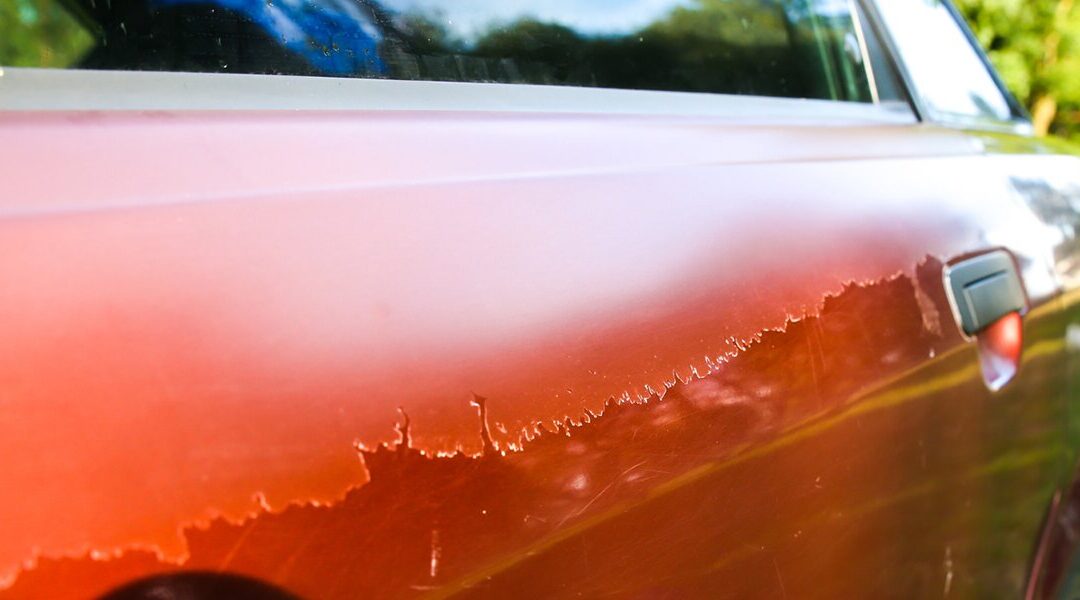
- Stage 3: Sub-Surface Delamination (Clear Coat Failure): The protective clear coat splits into distinct, microscopic layers and loses its structural elasticity. Once the acidic erosion breaches the clear coat and exposes the pigmented base coat beneath, the paint begins to flake, peel, and oxidize rapidly. At this point, the panel must be mechanically stripped and completely resprayed.
Defensive Countermeasures: Comparing Paint Protection Systems
Washing your vehicle promptly after a heavy rainstorm helps remove acidic residues before they can dry, but relying solely on maintenance is a risky gamble. To provide continuous, long-term chemical resistance, vehicle owners rely on modern sacrificial barriers.
The following comparison chart outlines how different paint protection layers handle environmental chemical attacks, helping you choose the right level of defense for your vehicle.
| Protection Method | Chemical Resistance Profile | Physical Material Barrier | Expected Durability |
| Organic Carnauba Wax | Low; easily degraded by low pH | Minimal temporary film | 4 to 8 weeks |
| Synthetic Polymer Sealants | Moderate; resists mild precipitation | Thin cross-linked layer | 4 to 6 months |
| Nano Ceramic Coatings ($SiO_2$) | High; repels acids down to pH 2 | Semi-permanent chemical bond | 2 to 5 years |
| Paint Protection Film (PPF) | Maximum; complete environmental isolation | 8-mil sacrificial urethane shield | 5 to 10 years (Self-Healing) |

The Power of Ceramic Coatings and PPF
For drivers seeking maximum insurance against environmental fallout, traditional waxes are no longer sufficient; they simply melt away under high thermal stress and acidic exposure. Modern nano-ceramic coatings utilize silicon dioxide ($SiO_2$) to create a flat, glass-like hydrophobic layer over the paint. This incredibly slick surface causes rainwater to bead tightly and roll off the body panels before evaporation can concentrate the acidic compounds.
Alternatively, Paint Protection Film (PPF) provides a physical, heavy-duty polyurethane membrane that entirely isolates the factory paint from the outside world. Any incoming acid rain damage on cars is completely absorbed by the sacrificial film, preserving the original factory finish underneath and locking in the car’s ultimate resale value.
Step-by-Step Restoration: How to Fix Acid-Etched Paint
If your vehicle has already fallen victim to environmental etching, a regular car wash will not fix the problem. Restoring the smooth, reflective finish requires a careful, mechanical decontamination and leveling process.
Step 1: Chemical Decontamination Wash
Thoroughly wash the vehicle using the two-bucket method and a dedicated pH-neutral stripping shampoo to remove loose road grime. Follow up with an iron-remover spray and a physical clay bar treatment. This lifts embedded industrial fallout and mineral deposits out of the micro-etched valleys without scratching the surrounding areas.
Step 2: Clear Coat Leveling (Paint Correction)
Because acid rain creates recessed craters in your paint, you must carefully level the surrounding clear coat down to the depth of the etch mark to make it invisible. Using a dual-action orbital polisher, pair a leveling cutting compound with a microfiber pad. Work in small, controlled sections, measuring clear coat thickness frequently to ensure you preserve a healthy layer of factory protection.
Step 3: Refinement and Finishing Polish
Once the deep etch rings are leveled out, switch to a soft foam finishing pad and a fine ultra-refining polish. This step removes any microscopic compounding haze, restoring absolute optical clarity and a deep, mirror-like showroom shine to the panels.
Step 4: Lock-In Sacrificial Protection
Newly corrected paint is completely bare and highly vulnerable to immediate re-etching. Always seal your hard work immediately by applying a high-grade ceramic coating or installing a protective film layer to ensure atmospheric pollutants never get a direct shot at your clear coat again.